AscendingPassage.com
See the: Egyptian Secrets Library

Giza: The Pyramids and Sphinx
Before you go ...
 Those who travel to Egypt are often treated to a tour of the pyramids at Giza, bounced to Luxor for a morning at Karnak and an afternoon looking at the empty rooms that were King Tut's tomb, a relaxing Nile cruise up to Abu Simbel because everybody else does it, and a mystifying few hours running through the Cairo Museum with a guide who knows the names of everything, and little more.
There is more, a lot more. The Egyptians had a far different world view from that of our time. There are scattered signposts that, taken together, point to a deep knowledge of the human experience.
If you visit Egypt, pause a lot. Sit with a statue or a temple and connect with the power there. It is still there, if you listen. And that means it is right here where you are now as well. Don't let the guides, in Egypt or anywhere else, hurry you along.
Most tours begin with the Giza Pyramids, but few point out that these giant structures - the largest ever built by man - were built at the earliest stage of Egyptian and thus human civilization. There is a gap, some important part of the story we do not know.
Giza is the burial ground of ancient Memphis, which was located a few miles south of modern Cairo. Memphis was sometimes the capital of Egypt, the Nile delta fans out just after the river passes there. The large area to the north was heavily populated, prone to flooding, and has had many yards (meters) of silt deposited over whatever ruins remain. Although half of ancient Egypt was north of Memphis, there is very little to see there.
Another gap is the focus of this website on the higher sense of Egypt. The Egyptian civilization treasured beauty and harmony, as much as any culture in history. Yet, the bulk of Egyptian religious practice was petty magic, and the temples often were more political and economic powers than spiritual. Still, there is something pure that rises to the top. Egypt is the home of Alchemy.

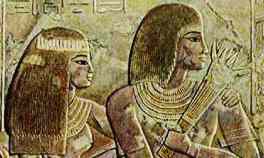
From the tomb of Thutmose III, Thebes.
11th hour of the Amduat.
Photograph by Hajor, CreativeCommons.
Here is the story of a journey to Giza written over a hundred years ago. Merely a day or two, for the Sphinx.
The Pyramids and Sphinx at Night
Excerpted and edited from La Mort De Philae
by Pierre Loti, published in 1909 and 1924
-- A WINTER MIDNIGHT
BEFORE THE GREAT SPHINX --
A night wondrously clear and of a color unknown to our climate. A
place of dreamlike aspect, fraught with mystery. The moon of a bright
silver, which dazzles by its shining, illuminates a world which surely
is no longer ours, for it resembles nothing that may be seen in
other lands. A world in which everything is suffused with rosy color
beneath the stars of midnight, and where stone symbols rise up,
ghostlike and motionless.

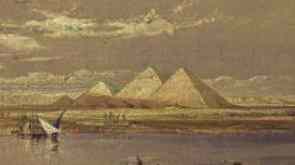
Pyramids in Moonlight
Postcard by Wolff Hagelberg 1901.
Is that a hill of sand that rises over there? One can scarcely tell, for
it has no shape, no outline, rather it seems like a great
rosy cloud. Perhaps some huge, trembling billow once raised
itself there, to become motionless for ever. . . . And out from
this kind of mummified wave a colossal human effigy emerges, rose-
colored too, a nameless, elusive rose. It emerges, and stares with fixed
eyes and smiles. It is so huge it seems unreal, as if it were a
reflection cast by some mirror hidden on the moon. . . .
And behind
this monster face, far away in the rear, on the top of those undefined
and gently undulating sandhills, three apocalyptic signs rise up
against the sky. Those rose-colored triangles, regular as the figures
of geometry, are so vast in the distance that they inspire you with
fear. They seem to be luminous of themselves, so vividly do they stand
out in their clear rose against the deep blue of the star-filled
vault. And this apparent radiation from within, by its lack of
likelihood, makes them seem more ominous.

The Pyramids of Gisa
By Lehnert and Landrock.
And all around is the desert, a corner of the mournful kingdom of
sand. Nothing else is to be seen anywhere save those three awful
things that stand there upright and still. The human likeness
magnified beyond all measure, and the three geometric mountains,
at first sight like exhalations. Visionary things, the features of the
vast mute face, subtleties of shadow which show that it
exists, rigid and immovable, fashioned out of imperishable stone.

Even had we not known, we must soon have guessed, for these things are
unique in the world. Pictures of every age have made the knowledge
of them commonplace: the Sphinx and the Pyramids! But what is strange
is that they should be so disquieting. . . . And this pervading color
of rose, where comes it, seeing that usually the moon tints with blue
the things it illuminates? One would not expect this color either,
which, nevertheless, is that of all the sands and all the stones of
Egypt and Arabia. And then too, the eyes of the statue, how often have
we seen them? We did not know that they were capable only of
their one fixed stare. Why is it then that their motionless regard
surprises and chills us, even while we are obsessed by the smile of
the sealed lips that seem to hold back the answer to the supreme
enigma? . . .
It is cold. A wintry mist rises low down in the little valleys of the sand.
And that again we were not expecting. Beyond question the English, by changing the course of the Nile, to water the earth and make it more productive, have brought here
the humidity of their own misty isle. And this strange cold, this
mist, light as it still is, seems to give an
added remoteness and finality to all this dead past, which lies here
beneath us in subterranean labyrinths haunted by a thousand thousand mummies.
And the mist, which, as the night advances, thickens in the valleys,
hesitates to mount the great daunting face of the Sphinx. It
covers with the merest and most transparent gauze. Like
everything else here tonight, this gauze, too, is rose-colored. Meanwhile the Sphinx, which has seen the unrolling of all the history
of the world, is
plunged in profound and mystic contemplation of the moon, its friend
for the last 5000 years, and notes impassively the change in Egypt's climate.
Here and there on the soft pathway of the sandhills are tiny figures
of men that move about or sit squatting as if on the watch. Small
as they are, low down in the hollows and far away, this wonderful
silver moon reveals even their slightest gestures. Their white
robes and black cloaks stand sharply out against the monotony
of the desert. At times they call to one another in a harsh, aspirate
tongue, and then go off at a run, noiselessly, barefooted, with
burnouses flying, like moths in the night. They lie in wait for the
parties of tourists who arrive from time to time.

The Pyramid of Chephren and the Sphinx
By David Roberts, 1839.
These great
symbols, during the hundreds and thousands of years that have elapsed
since men ceased to venerate them, have nevertheless scarcely ever
been alone, especially on nights with a full moon. Men of all races,
of all times, have come to wander round them, vaguely attracted by
their immensity and mystery. In the days of the Romans they had
already become symbols of a lost significance, legacies of a fabulous
antiquity. People came curiously to contemplate them, and tourists
in toga and in peplus carved their names on the stone of their bases
for the sake of remembrance.
The tourists who have come tonight, and upon whom have pounced the
black-cloaked Bedouin guides, wear cap and ulster or furred greatcoat.
Their intrusion here seems almost an offence. But, alas, such visitors
become more numerous each succeeding year. The town near by has become a place of rendezvous and holiday for the
idlers and upstarts of the whole world.

Napoleon and the Sphinx.
by Jean Gerome, 1862
The modern spirit encompasses
the old desert of the Sphinx on every side. It is true that up to the
present no one has dared to profane it by building in the immediate
neighborhood of the great statue. Its fixity and calm disdain still
hold some sway, perhaps. But little more than a mile away there ends a
road traveled by hackney carriages and tramway cars and noisy with
the delectable hootings of stylish motor cars. Behind the pyramid of
Cheops squats a vast hotel to which swarm men and women of fashion,
the latter absurdly feathered. They are joined by ancient English ladies, a little the worse for wear, who bring
their rheumatisms for the treatment of the dry winds.
Passing on our way we had seen this hotel and
these people in the glare of the electric lights, and from an
orchestra that was playing we caught the trivial air of a
popular refrain. Then, by a dip of the ground,
all this had disappeared. What a sense of deliverance possessed us,
how far away this turmoil seemed! As soon as we commenced to tread upon
the sand of centuries, where our footsteps made no sound,
nothing seemed to have existence, save only the great calm and the
religious awe of this world into which we have come, of this world where all seemed silent,
undefined, gigantic and suffused with rose-color.

The Pyramids and Sphinx of Giza
from "la Description de l'Egypte".
And first there is the Pyramid of Cheops, whose immutable base we had
to skirt on our way hither. In the moonlight we could see the separate
blocks, so enormous, so regular, so even in their layers. These stones lie
one above the other to infinity, getting ever smaller and smaller, and
mounting, mounting in diminishing perspective, until at last, high up,
they form the apex of this giddy triangle.
And the pyramid seemed to
be illuminated by some sad dawn, a dawn which
made ruddy only the sands and the stones of earth, and left the
heavens, pricked with their myriad stars, more awful in their
darkness. How impossible it is for us to conceive the mental attitude
of that king who, during thirty-some years, spent the lives of
thousands and thousands of his people in the construction of this
tomb, in the fond and foolish hope of prolonging to infinity the
existence of his mummy.

The Great Sphinx of Giza
by A. Lamplough, from the 1909 edition
of this book.
There was still a short way to go before we
confronted the Sphinx, in the middle of what our contemporaries have
left him of his desert. The sandhill we descended looked like a cloud and seemed as if covered with felt, in
order to preserve in such a place a more complete silence. Here
and there we passed a gaping black hole--an airhole, as it seemed, of
the profound and inextricable kingdom of mummies, very populous still,
in spite of the zeal of the exhumers.
As we descended the sandy pathway we were not slow to perceive the
Sphinx itself, half hill, half crouching beast. It had its back turned on
us like a gigantic dog that thought to bay the moon. Its head stood out in dark silhouette, like a screen before the light
it seemed to be regarding, and the lappets of its headgear showed like
downhanging ears.
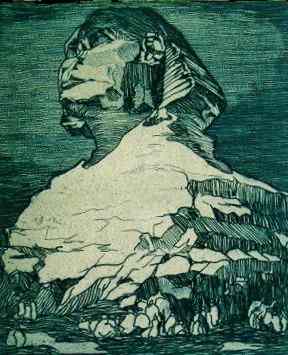 Then gradually, as we walked on, we saw it in
profile, shorn of its nose, but having
already an expression disdainful, with thrust-out chin and baffling, mysterious
smile. At length we arrived before the colossal visage, face
to face with it. Its' gaze passed
high above our heads. There came over us the sentiment of all
the secret thought which these men of old contrived to incorporate and
make eternal.
Then gradually, as we walked on, we saw it in
profile, shorn of its nose, but having
already an expression disdainful, with thrust-out chin and baffling, mysterious
smile. At length we arrived before the colossal visage, face
to face with it. Its' gaze passed
high above our heads. There came over us the sentiment of all
the secret thought which these men of old contrived to incorporate and
make eternal.
But in full daylight their great Sphinx is no more. It is greatly scarred by time. But after the manner of all phantoms, it
comes to life again at night, beneath the enchantments of the moon.
For the men of its time whom did it represent? King Chephren? The Sun
God? Who can rightly tell? Of all Egyptian images it remains the
least understood. The unfathomable thinkers of Egypt symbolised
everything for the benefit of the uninitiated under the form of awe-
inspiring figures of the gods. It may be, that, after
having meditated so deeply in the shadow of their temples, and sought
so long the everlasting wherefore of life and death, they wished
simply to sum up in the smile of these closed lips the vanity of the
most profound of our human speculations. . . .
It is said that the
Sphinx was once of striking beauty, when harmonious contour and
coloring animated the face, and it was enthroned at its full height
on a kind of esplanade paved with long slabs of stone. But was it then
more sovereign than it is tonight in its last decrepitude? Almost
buried beneath the sand of the Libyan desert, which now quite hides
its base, it rises at this hour like a phantom, nothing solid
sustains in the air.
It is midnight. In little groups the tourists of the evening
have disappeared to return perhaps to the neighboring hotel, where the
orchestra doubtless has not ceased to rage. Some--the stouthearted ones--departed talking loudly and with cigar in
mouth, others, however, lowered their
voices as people instinctively do in church. And the Bedouin guides,
who a moment ago seemed to flutter about the giant monument like so
many black moths, they too have gone. The show for tonight is over, and
everywhere silence reigns.

The wooden waterwheel creaks all night as it irrigates the fields
by Adrien Egron, 1837.
The rosy tint fades on the Sphinx and the pyramids, all things in the
ghostly scene grow visibly paler, for the moon as it rises becomes
more silvery in the increasing chill of midnight. The winter
mist, exhaled from the artificially watered fields below, continues to
rise, takes heart and envelops the great mute face itself. And the
Sphinx persists in its regard of the lifeless moon, preserving still the
old disconcerting smile. It becomes more and more difficult to believe
that here before us is a real colossus. It seems to be a diluted reflection of a thing which exists elsewhere,
in some other world. And behind in the distance are the three
triangular mountains. The fog envelops them, too, till they also
cease to exist, and become pure imagination.
Now an intolerable sadness is expressed in
those large eyes with their empty sockets. For, at this moment, the
ultimate secret, that which the Sphinx seems to have known for so many
centuries, is told: That all
these dead men and women who sleep in the vast necropolis below have
been fooled. The awakening signal has not sounded for a single one
of them. That the creations of mankind--mankind that thinks and suffers on the earth--are destined to become empty dust. That mankind's truest aspirations are elsewhere.
NEXT CHAPTER
La Mort De Philae, by Pierre Loti
... pen name of Louis Marie Julien Viaud (1850 - 1923).
Published as "Egypt", 1909,
editions Rene Kieffer, Paris, 1924.
Translated from the French by W. P. Baines.
Etext prepared by Dagny and John Bickers.
Adapted for AscendingPassage.com, 2006, 2017.

Approach of the Simoon (Sandstorm)
by David Roberts, 1838.
One of the most copied engravings of Egypt.
Additional images by Elysian Fields, George Arents, David Roberts
and Geo Colucci's massive Sphinx from the 1924 edition of M. Loti's book.
PYMD.com
Egypt's Pyramids have their own website: PYMD.com
Deep into the mysteries,
from the maker of this website...
Countless beautiful 19th century images of ancient Egypt
and 75 pages of architecture, art and mystery
are linked from the library page:

The Egyptian Secrets Library