AscendingPassage.com
See a list of chapters.

Dendera Temple

Photo by Steve F E Cameron, CreativeCommons.
The Great Temple at Dendera (Denderah, previously Tentyra or Tintyra) dates to the Ptolemaic period, about 100 BC. It is well preserved except for damage to the faces of the Hathor columns by early Christians. The current temple stands at the site of earlier construction dating back at least to the middle kingdom. Hathor was mistress of the cycles of time, the art of the temple reflects that, and the annual new year celebration there.
Excerpted and edited from La Mort De Philae
by Pierre Loti, 1924
CHAPTER XII -- IN THE TEMPLE
OF THE GODDESS OF LOVE AND JOY
The Hathor Temple at Dendera (Tentyra)
It is the month of March, but as warm and splendid as in our June.
Around us are fields of corn, of lucerne, and the flowering bean. And
the air is full of restless birds, singing deliriously for very joy in
their nests and coveys. Our way lies over a
fertile soil, saturated with vital substances--some paradise for
beasts no doubt, for they swarm on every side. Flocks of goats with a
thousand bleating kids; she-asses with their frisking young; cows and
buffaloes feeding their calves. All are turned loose among the crops,
to browse at their leisure, as if there were here an excess of
the riches of the soil. There is an abundance of light in the sky
and, in the distance, an extraordinary clearness.
These
fertile plains are bounded far away, on left and right, by two parallel stone walls,
two chains of rose-colored mountains, whose aspect is powerfully
desertlike.
The sun at this moment is hidden from us by a band of clouds that
stretches, right above our head, from one end of the sky to the other. It is alone in the blue void, and
seems to make more peaceful, and even a little mysterious, the
wonderful light of the fields we traverse. By contrast, the
distant landscape, unshaded by cloud, is resplendent with a more
incisive clearness, and the desert beyond seems deluged with rays.

The gateway (portico) to Dendera Temple,
by David Roberts.
The pathway that we have been following, ill defined as it is in the
grassy fields, leads us at length under a large ruinous portico which still rises here, quite
isolated, altogether strange and unexpected, in the midst of the green
expanse of pasture and tillage. We had seen it from a great distance,
so pure and clear is the air. In relief on its lintel is designed a globe with
two long wings outspread symmetrically.
 It behoves us now to pause,
for this winged disc is a symbol which gives at length an indication
of the place. And there before us must once have stood a temple
reverenced of the people, or some great vanished town. Fragments
of columns and sculptured capitals are strewn about in the fields of
lucerne. How inexplicable it seems that this land of ancient
splendors, which never ceased indeed to be nutritive and prodigiously
fertile, should have returned to the
humble pastoral life of the peasants.
It behoves us now to pause,
for this winged disc is a symbol which gives at length an indication
of the place. And there before us must once have stood a temple
reverenced of the people, or some great vanished town. Fragments
of columns and sculptured capitals are strewn about in the fields of
lucerne. How inexplicable it seems that this land of ancient
splendors, which never ceased indeed to be nutritive and prodigiously
fertile, should have returned to the
humble pastoral life of the peasants.
Through the green crops and the assembled herds our pathway seems to
lead to a kind of hill rising alone in the midst of the plains--a hill
which is neither of the same color nor the same nature as the
mountains of the surrounding deserts. Behind us the portico recedes
little by little in the distance. Its' tall imposing silhouette,
mournful and solitary, throws an infinite sadness on this sea of
meadows, which spread their peace where once was a center of
magnificence.
The wind now rises in sharp, lashing gusts--the wind of Egypt that
never seems to fall, and is bitter and wintry for all the burning of
the sun. The herded beasts move close to one
another and turn their backs to the squall.
As we draw nearer to this singular hill it is revealed as a mass of
ruins. The ruins are all of a brownish-red color. They are
the remains of the colonial town of the Romans, which subsisted here
for some two or three hundred years, an almost negligible moment of
time in the long history of Egypt. The town then fell to pieces, to become
in time mere shapeless mounds on the fertile margins of the Nile and in the submerging sands.
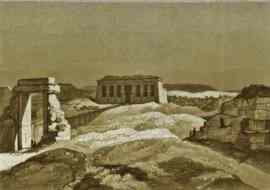 A heap of little reddish bricks that once were fashioned into houses;
a heap of broken jars or amphorae--myriads of them--that served to
carry the water from the old nourishing river; and the remains of
walls, repaired at diverse epochs, where stones inscribed with
hieroglyphs lie upside down against fragments of Grecian obelisks or
Coptic sculptures or Roman capitals. In our countries, where the past
is of yesterday, we have nothing resembling such a chaos of dead
things.
A heap of little reddish bricks that once were fashioned into houses;
a heap of broken jars or amphorae--myriads of them--that served to
carry the water from the old nourishing river; and the remains of
walls, repaired at diverse epochs, where stones inscribed with
hieroglyphs lie upside down against fragments of Grecian obelisks or
Coptic sculptures or Roman capitals. In our countries, where the past
is of yesterday, we have nothing resembling such a chaos of dead
things.
Nowadays the sanctuary is reached through a large cutting in this hill
of ruins. Incredible heaps of bricks and broken pottery enclose it on
all sides like a jealous rampart. Until recently indeed they covered
it almost to its roof. From the very first its' appearance is
disconcerting: it is so grand, so austere and gloomy. A strange
dwelling, to be sure, for the Goddess of Love and Joy. A severe
doorway, built of gigantic stones and surmounted by a winged disc,
opens on to an asylum of religious mystery, on to depths where massive
columns disappear in the darkness of deep night.
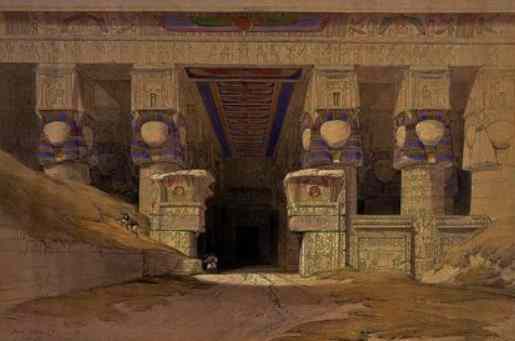
Dendera, by David Roberts, 1838.
Immediately on entering there is a coolness and a resonance as of a
sepulchre. First, the pronaos, where we still see clearly, between
pillars carved with hieroglyphs. Were it not for the large human faces
which serve for the capitals of the columns, and are the image of the
lovely Hathor, the goddess of the place, this temple of the decadent
epoch would scarcely differ from those built in Egypt two
thousand years earlier. It has the same square massiveness.
And in the dark blue ceilings there are the same frescoes, filled with
stars, with the signs of the Zodiac, and lines of winged discs. In
bas-relief on the walls there are the same crowds of people who
gesticulate and make signs to one another with their hands. -- Eternally
the same mysterious signs, repeated to infinity, everywhere--in the
palaces, the hypogea, and on the papyrus and sarcophagi of the mummies.

The Memphite and Theban temples, which preceded this by so many
centuries, and far surpassed it in grandeur, have all lost, in
consequence of the falling of the enormous stones of their roofs,
their cherished gloom, and, what is the same thing, their religious
mystery. But in the temple of the lovely Hathor,
except for some figures mutilated by the hammers of Christians or
Moslems, everything has remained intact, and the lofty ceilings still
throw their fearsome shadows.
The gloom deepens in the hypostyle which follows the pronaos. Then
come, one after another, two halls of increasing holiness, where the
daylight enters regretfully through narrow loopholes, barely lighting
the rows of innumerable figures that gesticulate on the
walls. And then, after other majestic corridors, we reach the heart of
this heap of terrible stones, the holy of holies, enveloped in deep
gloom. The hieroglyphic inscriptions name this place the "Hall of
Mystery" and formerly the high priest alone, and he only once in each
year, had the right to enter it for the performance of some now
unknown rites.
The "Hall of Mystery" is empty to-day, despoiled long since of the
emblems of gold and precious stones that once filled it. The meagre
little flames of the candles we have lit scarcely pierce the darkness
which thickens over our heads towards the ceilings. At the
most they only allow us to distinguish on the walls of the vast
rectangular cavern the serried ranks of figures who exchange among
themselves their disconcerting mute conversations.

Towards the end of the ancient and at the beginning of the Christian
era, Egypt, as we know, still exercised such a fascination over the
world. Its ancestral prestige and the sovereign permanence of its ruins imposed its
gods upon its conquerors, its handwriting, its architecture, nay, even
its religious rites and its mummies.
The Ptolemies built temples here
which reproduce those of Thebes and Abydos. Even the Romans, although
they had already discovered the vault, followed here the Egyptian
model, and continued those flat ceilings, made of monstrous slabs,
placed like our wooden beams. And so this temple of Hathor, built
though it was in the time of Cleopatra and Augustus, on a site
venerable in the oldest antiquity, recalls at first sight some
conception of the Ramsses.
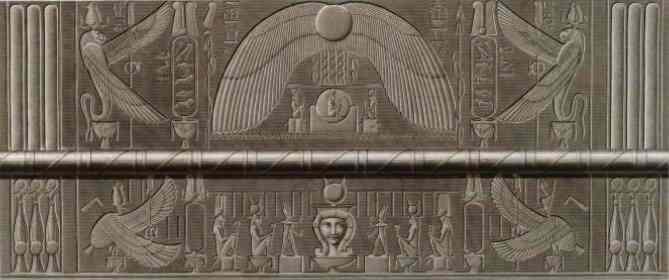
from La Description de lEgypte 1809
If, however, you examine it more closely, there appears, particularly
in the thousands of figures in bas-relief, a considerable divergence.
The poses are the same indeed, and so too are the traditional
gestures. But the exquisite grace of line is gone, as well as the
hieratic calm of the expressions and the smiles.
In the Egyptian art
of the best periods the slender figures are as pure as the flowers
they hold in their hands; their muscles may be indicated in a precise
and skilful manner, but they remain, for all that, immaterial.

from La Description de lEgypte 1809
For here, on
the contrary, the figures might be those of living people, palpitating
and voluptuous, who had posed themselves for sport in these
consecrated attitudes. The throat of the beautiful goddess, her hips,
her unveiled nakedness, are portrayed with a searching and lingering
realism; the flesh seems almost to quiver. She and her spouse, the
beautiful Horus, contemplate each other, naked, one
before the other, and their laughing eyes are intoxicated with love.
Around the holy of holies is a number of halls, in deep shadow and
massive as so many fortresses. They were used formerly for mysterious
and complicated rites, and in them, as everywhere else, there is no
corner of the wall but is overloaded with figures and hieroglyphs.
Bats are asleep in the blue ceilings, where the winged discs, painted
in fresco, look like flights of birds; and the hornets of the
neighbouring fields have built their nests there in hundreds, so that
they hang like stalactites.

Re-creation of the interior of the Temple at Dendera,
from La Description de l'Egypte 1809.
Several staircases lead to the vast terraces formed by the great roofs
of the temple--staircases narrow, stifling and dimly lighted by
loopholes that reveal the heart-breaking thickness of the walls. And
here again are the inevitable rows of figures, carved on all the
walls, in the same familiar attitudes. They mount with us as we
ascend, making all the time the self-same signs one to another.
As we emerge on to the roofs, bathed now in Egyptian sunlight and
swept by an Egyptian wind, we are greeted by a noise as of an
aviary. It is the kingdom of the sparrows, who have built their nests
in thousands in this temple of the complaisant goddess.
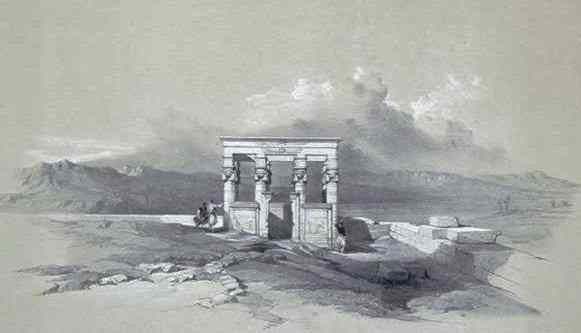
A small chapel built on the roof of Dendera Temple
By David Roberts, 1839.
It is an esplanade, this roof--a solitude paved with gigantic
flagstones. From it we see, beyond the heaps of ruins, those happy
plains, which are spread out with such a perfect serenity on the very
ground where once stood the town of Denderah, beloved of Hathor and
one of the most famous of Upper Egypt.
The temple has
also some underground crypts into which you descend by
staircases as of dungeons; sometimes you have to crawl through
holes to reach them. Long superposed galleries which might serve as
hiding-places for treasure; long corridors recalling those which, in
bad dreams, threaten to close in and bury you. And the innumerable
figures, of course, are here too, gesticulating on the walls. There are
endless representations of the lovely goddess.

The Gateway of Dendera
artist unknown.
In one of the vestibules that we traverse on our way out of
the sanctuary are numerous bas-reliefs representing various
sovereigns paying homage to the beautiful Hathor. One is of a young
man, crowned with a royal tiara. He
is shown seated in the traditional Pharaonic pose and is none other
than the Emperor Nero!
The hieroglyphs of the cartouche are there to affirm his identity,
albeit the sculptor, not knowing his actual physiognomy, has given him
the traditional features, regular as those of the god Horus. During
the centuries of the Roman domination the Western emperors used to
send from home instructions that their likeness should be placed on
the walls of the temples, and that offerings should be made in their
name to the Egyptian divinities. This despite that Egypt must have seemed so far away, a colony almost at the
end of the earth.
The Emperor Nero! As a matter of fact at the very time these bas-
reliefs--almost the last--and these expiring hieroglyphics were being
inscribed, the days of the Goddess of Joy were numbered.
How strange it is to say! Even while the sculptor was carving this
archaic bas-relief, and was using, for the engraving of its name,
characters that dated back to the dawn of the ages, there were
already Christians assembled in the catacombs at Rome!
Edited and excerpted from La Mort De Philae
by Pierre Loti, 1909, 1924
NEXT CHAPTER
The Dendera Zodiac
In an upper room of a smaller temple at Dendera was found a now-famous zodiac, now in the Louvre Museum (Paris). Archaeologists date the building where it was found to about 100 BC. Astrologers say it shows a date of about 700 BC. A much earlier date is attested to in an inscription that states that the temple was built according to the plans of Imhotep, which would place the building of the original temple at about 2650 BC.


The walls of the Zodiac Chamber
from La Description de l'Egypte 1809.
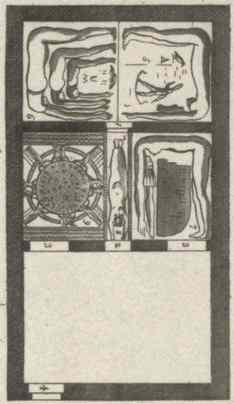
The Dendera Zodiac is one of four roof paintings in its' temple. The other three show Nut the sky goddess in several poses. Drawings by Viviant Denon.


Dendera Zodiac by Viviant Denon

Denderah Typhoon Temple from the side.

Another view of the Typhoon Temple, Dendera.
Photograph by Felix Bonfils.

Temple ruins near Dendera by Viviant Denon
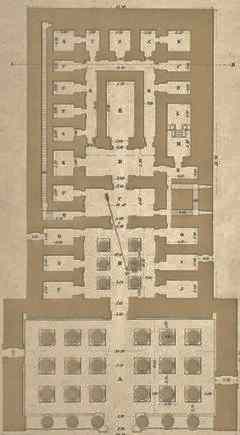
Dendera Plan
by Mariette 1869
Additional artwork by Hector Horeau (2) and David Roberts
Countless beautiful 19th century images of ancient Egypt
and 75 pages of architecture, art and mystery
are linked from the library page:

The Egyptian Secrets Library