AscendingPassage.com
See the: Egyptian Secrets Library

Kardassy Temple
Built during the Ptolemaic period, late in Egyptian history, Kardassy (Qertassi) Temple was relocated to protect it from the waters of Aswan dam to the same island on which Kalabsha temple was placed. Judging from photographs the new location has not the magic of the original.
Kardassy Fort and Temple
Excerpt from: Travels in Nubia by John Lewis Burckhardt
A Journey along the Banks of the Nile
Published in 1819. Adapted for AscendingPassage.com, 2006.
March 29th, 1813.
Soon we passed Kardassy (Kardeseh, Qertassi or Gartass), where close to the water is a large
stone enclosure, about one hundred and thirty paces in length by
one hundred in breadth; in its area are heaps of ruined dwellings
built of stone. The entrance into this enclosure is by a large
gateway, similar in shape to that in the front of the temple near
Merowau. The walls are about ten feet in thickness,
and are faced on either side with hewn stones, having the center
filled up by small ones thrown in confusedly, without cement.

Hilltop Temple of Hathor at Kardassy,
by David Roberts, 1838
 About a mile farther down
the river, upon the top of a hill, are the ruins of a temple,
resembling in its construction that of the Kiosk at Philae. There remains no part but the portico. It consisted
originally of eight columns, of which six are still standing; these are partly united with
each other by a wall, rising
to half their height, and inclosing the whole of them. Of the
stones which formed the roof, one block only remains; it is at
least sixteen feet in length, and reaches the whole breadth of the
temple. The architraves still remain over four of the columns, the
capitals of the two others are formed by four faces of Hathor, with
the same head-dress as at Tintyra (Dendera), but with countenances more
juvenile and less grave. The ears are very peculiar. There is a sculptured figure on one of the columns
only; the others bear traces of having been covered with
hieroglyphics.
About a mile farther down
the river, upon the top of a hill, are the ruins of a temple,
resembling in its construction that of the Kiosk at Philae. There remains no part but the portico. It consisted
originally of eight columns, of which six are still standing; these are partly united with
each other by a wall, rising
to half their height, and inclosing the whole of them. Of the
stones which formed the roof, one block only remains; it is at
least sixteen feet in length, and reaches the whole breadth of the
temple. The architraves still remain over four of the columns, the
capitals of the two others are formed by four faces of Hathor, with
the same head-dress as at Tintyra (Dendera), but with countenances more
juvenile and less grave. The ears are very peculiar. There is a sculptured figure on one of the columns
only; the others bear traces of having been covered with
hieroglyphics.

Another view of the Temple at Kardassy,
by David Roberts, 1838
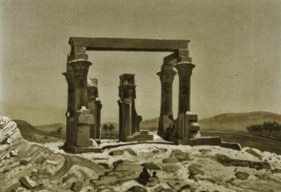
by Hector Horeau, 1841.
Our senses serve to affirm, not to know.
Isha Schwaller: "Her-Bak"
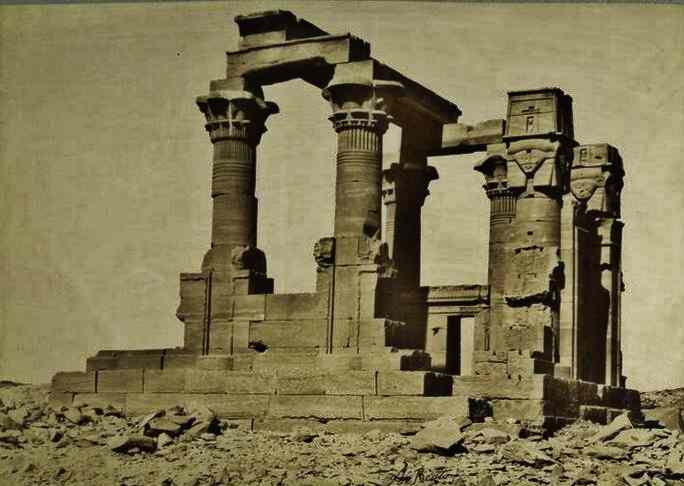
Photograph of Kardassy Temple by Antonio Beato 1850

Reconstruction of Kardassy Temple,
by François Chrétien Gau, 1819
To the S.W. of the hill on which the above temple stands, and close to the river, are some very
extensive quarries of sandstone, from whence the materials were
probably taken for the erection of the temples at Philae
and Parembole, where the rocks are entirely of granite. In walking
through the quarries, I came to a spot where a niche was cut in the
levelled side of the rock. Within it is a stone bench, which may
have been the pedestal of a statue, Small winged globes are
sculptured above it. This niche seems to have been used by the
ancient Egyptians, and subsequently both by the Pagan and Christian
Greeks, as a shrine at which they offered up their prayers to the
deity for the preservation of their own health and that of their
friends. Several heads of Greek saints are sculptured in the rock
on both sides of the niche. I also observed whole length
figures, and small sphinxes only three or four inches in
length, representations, perhaps, of similar images of gold or
silver offered to the deities.
NEXT CHAPTER
The Temple of Kardassy
excerpt from: Travels in Nubia
by John Lewis Burckhardt, published in 1819

Countless beautiful 19th century images of ancient Egypt
and 75 pages of architecture, art and mystery
are linked from the library page:

The Egyptian Secrets Library