AscendingPassage.com
See the: Egyptian Secrets Library

The Temple of Beit el Wali
The small temple of Beit el Wali (Bet el Walli or Dar el Wali), was built during the reign of Rameses II by the governor of Nubia to honor the god Amun-Re and, of course, Ramesses II. The statues were badly damaged by the early Christians, but the inner paintings are in good condition.
Beit el Wali temple was moved to higher ground and placed in an artifical looking hillside, near the larger Kalabsha temple, to avoid being flooded by the Aswan dam.

The Temple of Beit el-Wali
Excerpt from: Travels in Nubia
by John Lewis Burckhardt
Published in 1819.
Photograph at right by John Campana.
About a quarter of an hour north from Kalabsha temple is a small temple cut out of the rock; the road to
it lies through the remains of the ancient town, a heap of stones
and rubbish, covering a space along the shore of about a mile and a
quarter. In front of the temple is an open area (also hewn out of
the rock), in which is the entrance to the cella; the cella is
thirteen paces in length, by six in breadth; its roof is supported
by two polygonal pillars; in the walls are two small recesses, with
three statues in each. Adjoining the cella is the adytum, a small
room, eight feet square. The sculptures and hieroglyphics on the
walls are of the same rude execution as those at Derr.
The walls of the open area in front of the temple are covered with
sculptures representing very interesting historical subjects: on one side is a battle; the victor in a
chariot drawn by two fiery steeds, like those at Karnac, is
driving his vanquished enemies before him. These enemies are flying towards a
country thickly covered with fruit trees of various shapes and
sizes, some of which have large round leaves and clusters of
fruits hanging from them, with apes sporting amongst the branches.
Behind the victor's car are two smaller ones, of the same
form, each drawn by two horses at full speed; and bearing a female,
standing upright, with a charioteer in front holding the reins. In
another compartment on the same wall, is a triumphal procession
passing before a seated Osiris.

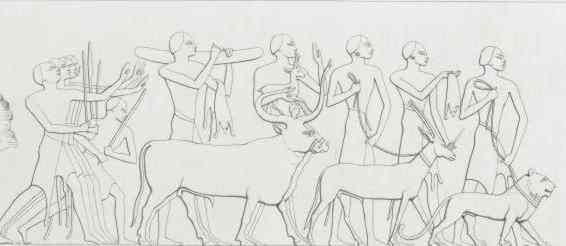
Register of animals, temple of Beit el Wali
by Salvador Cherubini, 1832-44.
Either the artist or the writer
has confused the order of the animals.
Men come first bearing upon
their shoulders large blocks of wood, probably ebony. One of them leads a wild mountain goat, a second carries an
ostrich, a third holds in one hand a large shield, and in the other
a gazelle, and a fourth is bringing an ape into the royal presence.
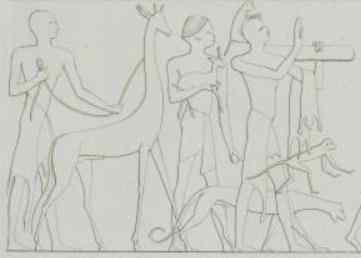
more animals, temple of Beit el Wali
by Salvador Cherubini, 1832-44
Next comes a man bearing a block of precious wood, like the former,
and driving two large buffalos before him. The parade is closed by
a tall cameleopard (giraffe?), with its leader.
Top register of animals, temple of Beit el Wali
by Salvador Cherubini, 1832-44
In another compartment, just above the latter,
is a large lion with his keeper; an animal of the size of a large
goat, with long straight horns, and a pair of
buffaloes. In front of these two compartments, and before the king,
lie heaps of quivers and arrows, elephants teeth, skins and furs of
wild beasts, and a row of calabashes, perhaps containing
precious ointments or perfumes.

Ramesses II and Horus, temple of Beit el Wali.
Photo by Rivertay, CreativeCommons.
All the subjects are in bas-relief, and extremely well executed. They are the best specimens of historical sculpture that I have
seen in the valley of the Nile, even more spirited than those at
Thebes. The figures of the animals, in particular, are faithfully
and correctly delineated. I believe they will be found very important, because they record a
historical fact, no where else alluded to in any Egyptian
structure. The hero of Egypt has here carried his arms into a
country inhabited by lions, cameleopards, apes, and elephants, none
of which animals are found in Nubia or Dóngola. The elephant and
cameleopard inhabit the banks of the Nile towards Sennaar, the
forests on the frontiers of Abyssinia (Ethiopia), and the banks of the
Astaboras and Astapus: all the
above-described trophies of victory, therefore, indicate that the
battles must have been fought in the countries to the south of the
civilized country of ancient Meroe.
The battle-pieces of
Thebes, Luxor and Karnac seem to allude to less distant scenes
of warfare. May not the castles, surrounded with water, which are
there represented relate to the fortified islands in the Batn el
Hadjar, where we still meet with so many brick ruins? The headdress
of the fugitives and the short narrow beard under the
chin are perfectly characteristic of the southern Nubians. It may readily be imagined that the
inhabitants of the sterile districts of Nubia, and the Batn el
Hadjar, would look with an envious eye upon the riches of Egypt.
The small temple I have just described is called by the natives
Dar el Waly. Travelers proceeding by water are not likely to see
it without enquiring for it. In the hill close by, are the
quarries where the stones were hewn for the erection of the town
and temples of Kalabshe. This, no doubt, was the ancient
Talmis, and some mounds of rubbish on the east side
indicate the remains of Contra-Talmis. Talmis must have
acquired its opulence by commerce, and not by agriculture, as the
shore in its neighborhood is no where more than forty yards in
breadth.
We halted for the night, a little way beyond Dar el Waly, at Khortum, a village
opposite the island of Darmout.
NEXT CHAPTER
Excerpt from: Travels in Nubia
by John Lewis Burckhardt
Published in 1819.

Countless beautiful 19th century images of ancient Egypt
and 75 pages of architecture, art and mystery
are linked from the library page:

The Egyptian Secrets Library