AscendingPassage.com HOME PAGE.
See the: Egyptian Secrets Library.


Meroe
(Meroë, Méroé or Begrawiya)
The Nubians of the Kingdom of Kush ruled Egypt from about 750 to 650 BC, in what is now called the Twenty-fifth Dynasty. Eventually they were pushed out of Southern Egypt and back into modern Sudan. Continuing warfare required the movement of the capital first to Napata and then southwards to Meroe (in 590 BC) near the sixth cataract of the Nile. Here, for nearly a thousand years, Egyptian styles and religion continued to evolve, little impacted by the decline of Egypt in the north.

The pyramids of Meroe, Group C,
by Ernst Weidenbach, 1845
In the second century BC the Meroitic kingdom controlled a large area, reaching from the third Nile cataract to present day Khartoum. The gold fields so coveted by the Pharaohs had mostly played out by then but Meroe found wealth in mining another mineral - iron. Indeed the tools and weapons of the iron age in Africa were largely from Meroe.
Public works such as temples and a complex irrigation system show the ability of Meroe's rulers to organize a large work force. The wealthy, at least, led comfortable lives.


Two of the larger pyramids of Meroe, by Ernst Weidenbach, 1845

(left) Group A, by Weidenbach.
Along with Egyptian culture, Meroe adopted the Hieroglyphic system of writing. Yet Meroe allowed this writing system to evolve and incorporate Nubian concepts to the point that the writings of Meroe are mostly untranslatable by today's scholars.
Women in Meroe held considerable power, the choice of the next king was made primarily by the Queen Mother. Temple walls sometimes showed the Queen or a Goddess smiting the bad guys alongside the King.

The Queen and Anubis probably offering sacred oil, by Eirund, 1850

The art of Meroe, while clearly Egyptian in character, has a different feel
by Ernst Weidenbach, 1845.
Access to Meroe was difficult, although trade with the Mediterranean via the Nile and across the Red Sea with India continued. The Roman garrison in Egypt fought many skirmishes with the Southerners, but overall they believed the region too poor to be worth conquering. As the centuries passed the environment of the region declined due to deforestation brought on by the need for wood to fuel iron smelting. This weakened Meroe and caused it to be increasingly attacked by its' neighbors.
About 350 AD the Ethiopian state of Axum destroyed the city of Meroe, beyond this date there is no historical evidence of the kingdom. Were the people of Meroe assimilated or killed by their conquerors? This is the modern assumption, although there is another possibility. The Dogon Tribe of modern Mali (West Africa) claim Egypt as their heritage. These are the people who stunned scientists with their knowledge of the two (invisible to the unaided eye) companion stars of Sirus. Are the Dogon and related tribes cultural descendants of Meroe?

Group B of Meroe's Pyramids
by Weidenbach 1845
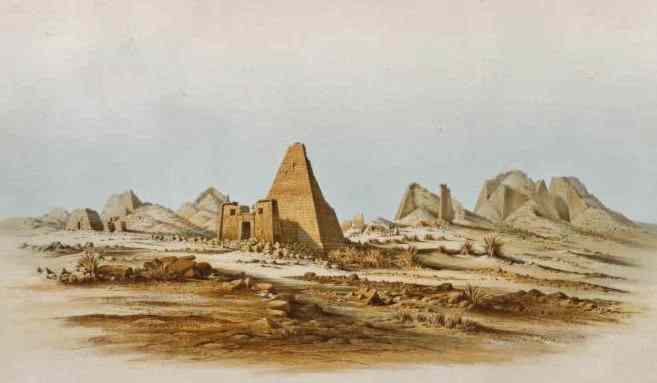
Treasure hunters in the nineteenth century
did great damage to many pyramids at Meroe
Lithograph by Ernst Weidenbach, 1845.
~~~~~~~~~~~~~~~~~~~~~~~~~~~~~~~~~~~~~~~~~~~~~~~~~~~~~~~~~~~~~
Cities of the Meroitic Kingdom

Mesaurat-Sufrah

Naga
Both Lithographs by Ernst Weidenbach, 1845.
For the first part of the story of Sudan's Pyramids see:
Kush at Gebel Barkal

Countless beautiful 19th century images of ancient Egypt
and 75 pages of architecture, art and mystery
are linked from the library page:

The Egyptian Secrets Library